You kept the music. Musicae keeps everything around it.
The versions, the compilations, the booklet, the year you were sixteen — a native music system for the collection you actually own. For people who kept their music.
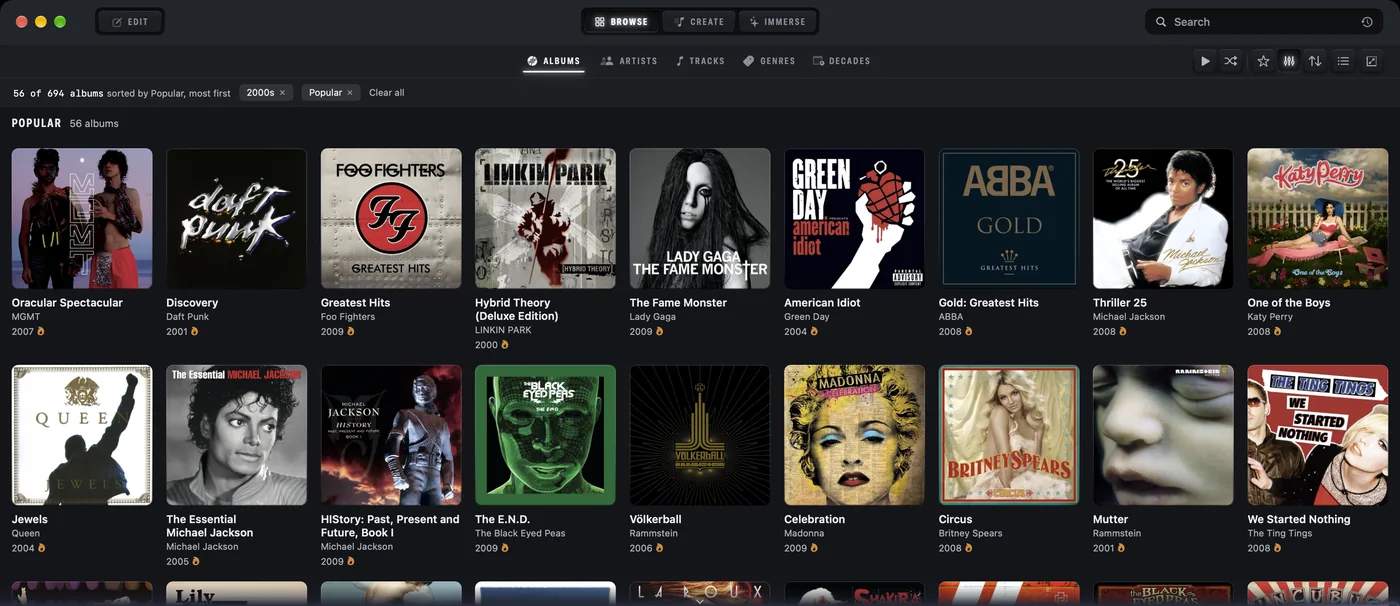
Something doesn't add up. Musicae notices.
You type a sentence. It knows which year you mean.
Start anywhere. It knows what it started from.
A collection lives in four layers. Most software sees one.
You already have the music.
The problem is remembering what is in it.
Not missing. Out of sight.
See what you actually own.
Artists. Albums. Singles. Maxis. Compilations. Genres. Decades. Series. Tracks. These stay different things — nothing collapses into a generic “release”.
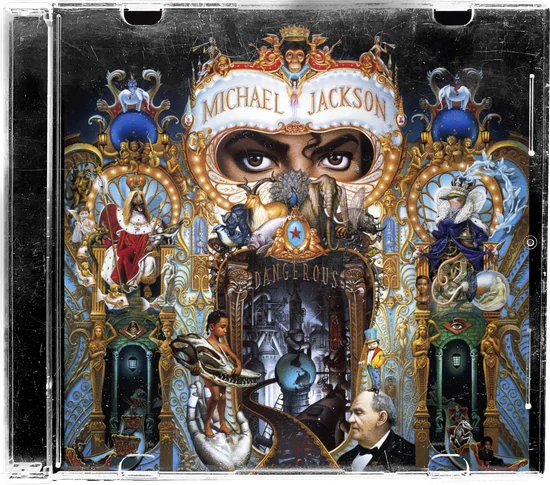
An album was an object before it became a thumbnail.
Music was never just an audio file.
In Musicae, the cover is shown at 120 millimetres — the size of the real thing, not whatever fits. The booklet — credits, artwork, lyrics, photographs — belongs to the album.
Booklets · in 1.0
The context is already there when you arrive.
A folder of files knows a title and an artist. Everything around it Musicae gathers quietly from open music databases, once, and keeps in your library — so a record you open at midnight already has its story attached.
And the words arrive one line at a time: lyrics sit in the player as the single line being sung, not a wall of scrolling text — and when the timing is off by a second, you can nudge it.
One song. Several versions.
Original, radio edit, extended mix, remix, the cut on the compilation. Musicae keeps them together as one work — a large library stops looking like a pile of duplicates. Compilations stay compilations, and a series stays a series.
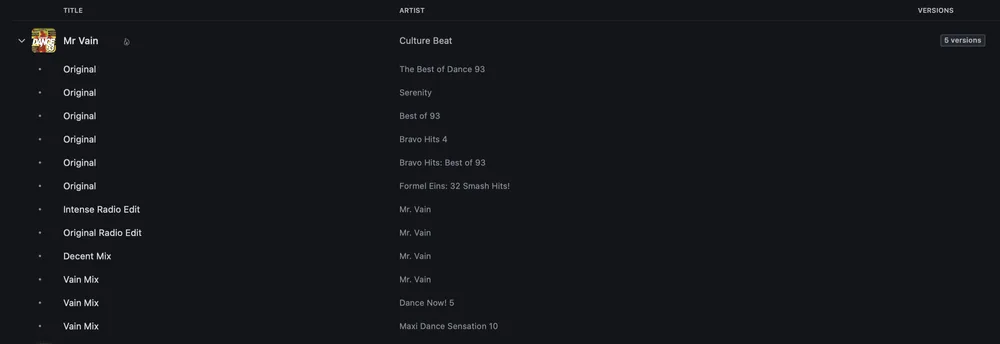
One line in the list, 12 files behind it, 5 versions among them — the same original on six different compilations, then the radio edits, then the long ones. You see the work. The files stay where they are.
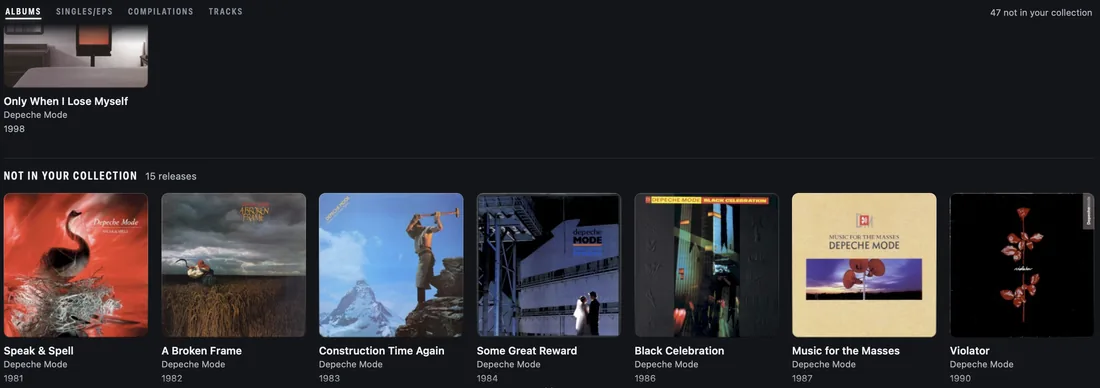
What the artist released, next to what you have.
Your library knows when something doesn't add up.
Two discs on one release, ten years apart. Musicae finds it, says where the contradiction comes from, and proposes the correction — then stops and waits for you.
Findings today · writing back to your files, 1.0
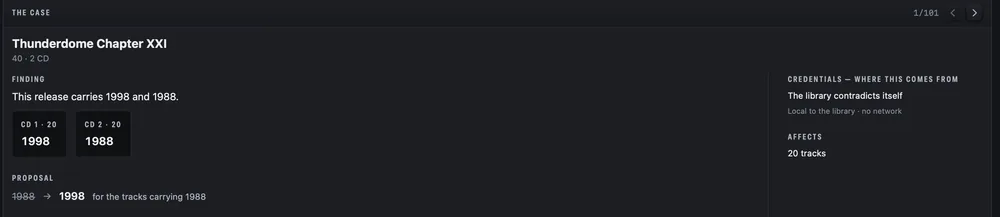
It says this looks wrong, never I corrected it. In this library the checking sheet holds 101 releases whose discs disagree about the year — each one a case you can read, accept or dismiss.
Nothing changes a file you didn't ask it to. Everything it changes, it can put back. Writing back to your files arrives in 1.0 — under that rule, or not at all.
Start anywhere. It knows what it started from.
Every object in Musicae carries the same four actions. Two of them play what you are looking at. The other two make something new from it — and that is where the starting point matters, because a track, a sampler and a year tell the app very different things.
- The Real Thing (extended) — 2 Unlimited1994 · 6:18 · a long version, like yours
- Move It Up (KM 1972 mix) — Cappella1994 · 5:34 · same era, same beat
- Saturday Night (Nite mix) — Whigfield1994 · 5:30 · 130 BPM
Not the eight other cuts of Mr. Vain you own: one version per work, so the list is eight songs instead of one song eight times.
Similarity is not enough. Context matters.
There is no model here and nothing to train — ten measured properties of the music itself, weighed against your own collection. The same actions sit on a track, an album, an artist, a compilation, a series, a genre, a year, a decade, a phase of your life — and any view you filtered yourself.
Make a thought playable.
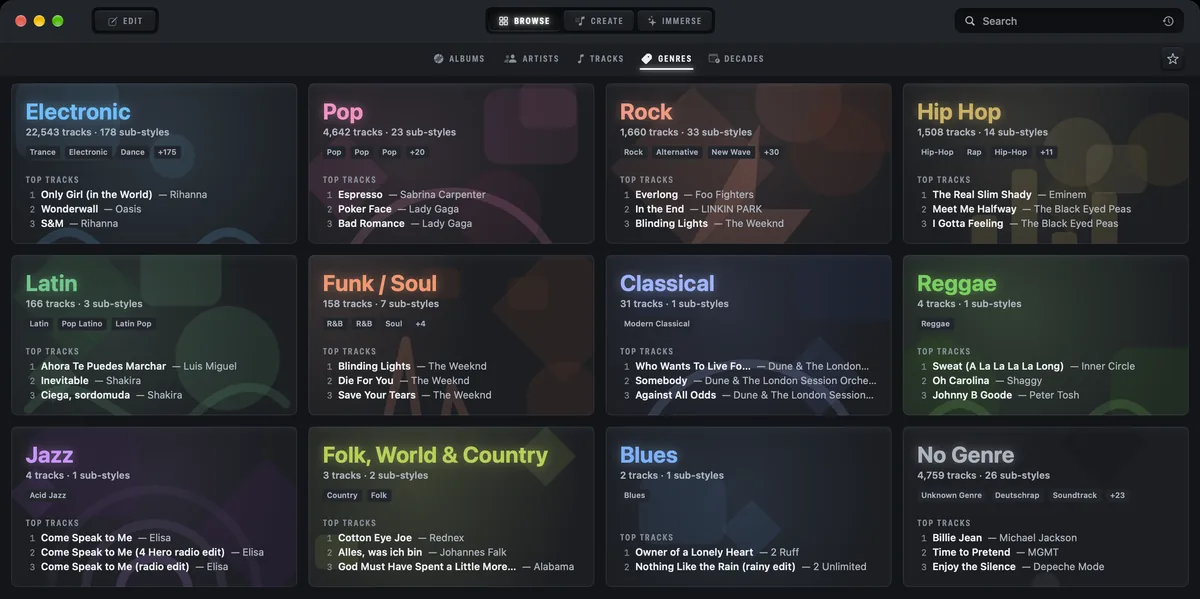
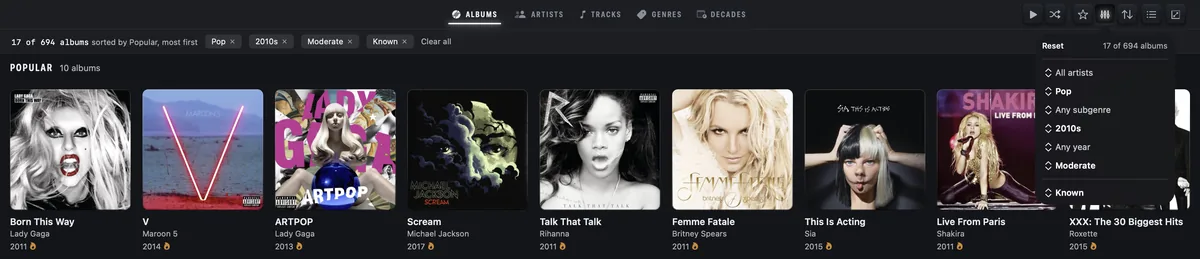
Start from a genre, from the years of your life, or from what the music came on. Each step narrows; stop at any of them — every stage plays. No playlist has to be built first.
Click a step.
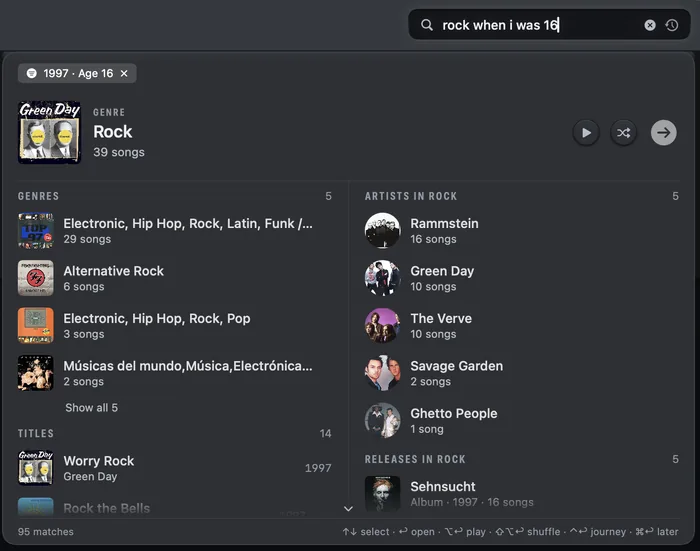
Search for music. Not filenames.
Genre, decade, tempo, a name, an age — no prefixes, no syntax. What comes back is grouped the way a collection is: releases, genres, titles, artists — and the artists standing next to them, which you did not ask for. Any of it can be played, shuffled, opened, filtered further or handed to Create.
Fidelity is the default. Coloration is an action.
Every stage in the chain is off until you switch it on, and the chain shows which ones are working. The whole way from the file to the output is named: the device you chose, the rate it is set to, nothing of Musicae's in between. Tracks that were mastered to run into each other still do. And where you want one track to give way to the next, the crossfade takes its shape from the two tracks it joins rather than from a fixed curve — optional, because not every record wants one.


What must never fail.
The qualities that decide whether the rest is believable, and that no screenshot can show.
From discovery to curation.
A set you liked should not disappear when the music stops. Create is the room where you shape it — and it asks the questions a record dealer would ask, not an algorithm.
Every song you own knows how old you were.
Decades are one axis. Childhood, early teens, teenage years, coming of age are another — gates you can open like any genre, and filter further from there.
Musicae does not say “you listened to this back then”. It says: this music came out when you were this age. Your name and birth year never leave the device.
Take what matters with you.
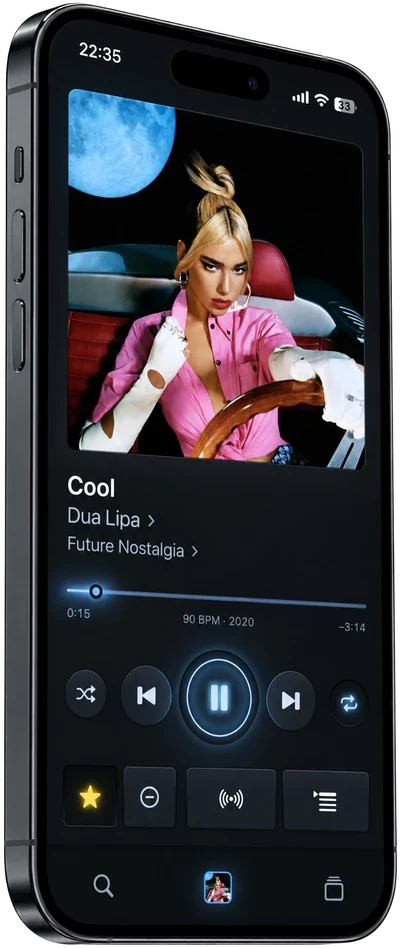
The Mac is the archive: analysis, repair, curation. The phone carries a chosen part of it. Because the analysis runs on your Mac and the library is a file, the knowledge travels with the music — the tempo on that screen was measured at home, and so was the year.
iOS companion · in 1.0
Personal without profiling.
Musicae asks MusicBrainz, Discogs and Last.fm about a title, an artist, an album. It never sends your library anywhere. If one of them disappears, Musicae keeps working — with fewer pictures.
Native, and you can tell.
Written for macOS in Swift, against the frameworks the system already has. Nothing here is a claim about a logo — each line is something the software does, and you would notice if it stopped.
The full sheet — frameworks, measurements, storage — is on the technical page.
Own the music. Own the software.
Streaming manages access. Musicae takes care of your collection — so the software should feel like ownership, too.
Built carefully. Released when ready.
This is a long-term instrument, not a disposable app.
Made by someone with 35,480 songs.
Musicae is built by one person, for a collection that grew over decades of ripped and bought CDs — and that every player treated as a list of files. It started with one irritation: the software knew my files and nothing about my collection. Not the versions, not the compilations, not the year I was sixteen.
Built by a music lover, for music lovers.

Musicae is in development.
Get notified when the first public version is ready.
No countdown. No waitlist ranking. Nothing until there is something to announce. What happens to the address.